 When you chat with friends about settling debts or splitting the
bill, Facebook doesn’t want you to have to open another app like PayPal
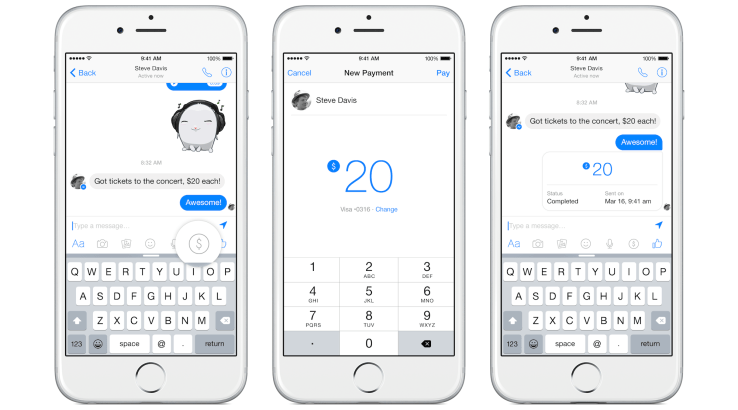
or Venmo to send them money. So today it unveiled a new payments feature for Facebook Messenger that lets you connect your Visa or Mastercard debit card and tap a “$” button to send friends money on iOS, Android, and desktop with zero fees. Facebook Messenger payments will roll out first in the U.S. over the coming months.
When you chat with friends about settling debts or splitting the
bill, Facebook doesn’t want you to have to open another app like PayPal
or Venmo to send them money. So today it unveiled a new payments feature for Facebook Messenger that lets you connect your Visa or Mastercard debit card and tap a “$” button to send friends money on iOS, Android, and desktop with zero fees. Facebook Messenger payments will roll out first in the U.S. over the coming months.Facebook And PayPal: Frenemies?
Rather than lean on a payments company like PayPal to power the feature, Facebook built it from the ground up from its experience processing over 1 million payments a day through its ads and games platforms. Transactions and payment info are encrypted, and Facebook says “These payment systems are kept in a secured environment that is separate from other parts of the Facebook network and that receive additional monitoring and control,” from an anti-fraud team.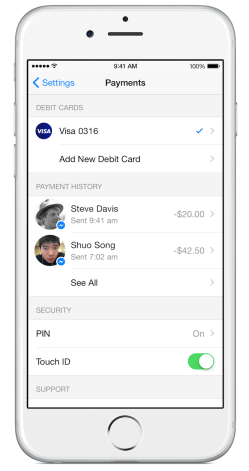 By
making payments part of its oft-used messaging service rather than a
standalone app, Facebook is looking to edge out dedicated P2P payment
competitors like Venmo/PayPal, Google Wallet, and Square Cash, which
people open less frequently. That’s the same strategy as the Square
Cash-powered Snapcash feature Snapchat launched in November.
By
making payments part of its oft-used messaging service rather than a
standalone app, Facebook is looking to edge out dedicated P2P payment
competitors like Venmo/PayPal, Google Wallet, and Square Cash, which
people open less frequently. That’s the same strategy as the Square
Cash-powered Snapcash feature Snapchat launched in November.PayPal gave a statement (emphasis mine) saying:
When I asked a PayPal spokesperson if the company views Facebook Messenger payments as a “competitor,” they carefully avoided that word but eventually admitted “it does have similar technology and does a similar thing to what Venmo does.” While Venmo makes transfers with most debit cards free, Facebook’s free service will undercut PayPal’s 2.9 percent plus $0.30 fee per transaction from debit cards.We have had a great relationship with Facebook since 2008 and currently work closely together to deliver easy payments on a global scale for its games and ads businesses.PayPal has always taken a partnership approach to payments and we will continue to work with Facebook and many other companies on new payments experiences that make it easier for people to send and receive money on both the PayPal and Braintree platforms.
“We’re not building a payments business here,” Facebook’s product manager on the feature Steve Davis tells me. Instead, Davis says the goal is to offer P2P payments for free to make Messenger “more useful, expressive and delightful.” Since Facebook makes so much money on ads, $3.59 billion in Q4, it doesn’t have to monetize payments directly. Facebook just needs to keep people locked into its platform and seeing News Feed ads by making Messenger as helpful as possible.
Payments In Messenger
TechCrunch was the first to report Facebook was building peer-to-peer payments into Messenger back in October when we attained hacked screenshots dug out of Messenger’s code by developer Andrew Aude. Since then, I’ve heard from several sources that Facebook was doing intense internal testing of the feature.In the meantime, Facebook worked with PayPal, Braintree and Stripe to power auto-fill of billing details for e-commerce checkouts, and built a Buy button for making purchases from the News Feed.
Davis says the product evolved from a different initial but was cagey about exactly how long Facebook has been working on the feature. He did note that it was well in the works when the company poached PayPal president David Marcus to run its Messenger division.
“We wanted to test this and make sure we had really hit a high bar because money is extremely important.” Now its payments in Messenger is ready for a gradual public rollout stateside. Here’s how it works.

 For
extra security, users are prompted to set an in-app payments passcode
or Apple TouchID fingerprint to confirm transfers, though they can opt
out of this extra authentication in the settings. If users already have a
debit card on file with Facebook from gaming, ads or donations, they
can use that, too.
For
extra security, users are prompted to set an in-app payments passcode
or Apple TouchID fingerprint to confirm transfers, though they can opt
out of this extra authentication in the settings. If users already have a
debit card on file with Facebook from gaming, ads or donations, they
can use that, too.Once the $ button is tapped, users enter the dollar amount and hit Pay. The money is instantly taken from their debit account and delivered to the recipient’s debit account. Facebook never holds the money, though the receiver’s bank will usually take a few days to make the funds available as is standard. Both users see a confirmation message detailing the transfer status and time.
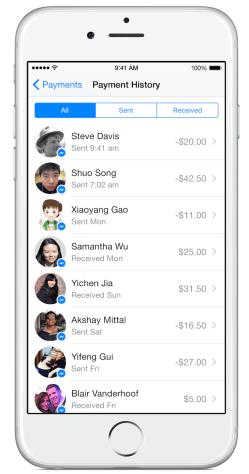
In case anything looks fishy, Facebook will ask users some extra financial security questions before a transfer goes through. Afterwards, users can see all their previous payments and funds received in the Payments History section of Messenger’s settings.
“It’s obviously not a feature you’re going to use 10 times a day,” say Davis. “But when you do need to send money, this is probably going to be the best way to do it.”
Convenience Is King
Davis explains that “conversations about money are already
happening on Messenger,” as people chat about bar tabs, splitting
dinner bills, and sharing the cost of an Uber. “What we want to do is
make it easy to finish the conversation in the same place you started.
You don’t have to switch to another app,” Davis tells me.
Now the question is whether this is the first step towards
Messenger becoming a more full-featured experience. Messenger could
follow the trend of monolithic chat apps of Asia
like WeChat that let you make payments, e-commerce purchases, hail
taxis and more. Messenger is going to have announcements at next week’s
f8 developer conference, and we could see more platform ambitions from
it then.
While only in the U.S. for now, if Facebook opened up
Messenger payments internationally, it could help migrant workers send
money home much cheaper than through high-fee remittance services. But
for now, Facebook says it just wants to get friend-to-friend payments
right in the States. “We’ll consider where to take it after that once we
get everything nailed down,” says Davis.
When people’s money is at stake, there’s no room for bugs.