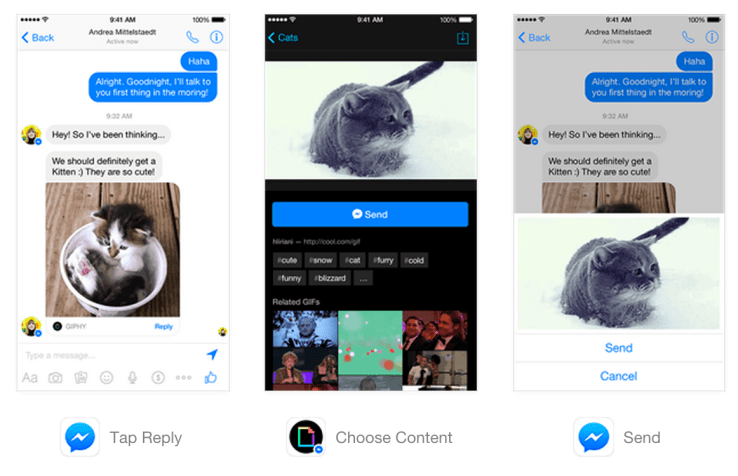
 Today at its F8 conference, Facebook announced its new Messenger Platform
that will allow its 600 million users to create and share content with
third-party tools, and communicate directly with businesses rather than
calling or emailing them. The content tools platform and apps from
initial partners including ESPN, JibJab, and Giphy, will become in an Messenger update
available today. Facebook is working with a limited set of partners for
business chat, which will roll out sometime in the future.
Today at its F8 conference, Facebook announced its new Messenger Platform
that will allow its 600 million users to create and share content with
third-party tools, and communicate directly with businesses rather than
calling or emailing them. The content tools platform and apps from
initial partners including ESPN, JibJab, and Giphy, will become in an Messenger update
available today. Facebook is working with a limited set of partners for
business chat, which will roll out sometime in the future. Facebook today released an SDK to help developers start building experiences for Messenger.
The announcement confirms my scoop from last week that Facebook would launch a Messenger Platform
focused on content. Facebook Messenger head David Marcus tells me “In
the West, it’s the first messaging platform at the scale of 600
million-plus users that’s opened up to developers.”
Facebook also launched a slew of new capabilities for
Parse developers, advertisers, websites, and the News Feed. You can see
all the announcements in our “Everything Facebook Launched At F8″ page.
Messenger Content Apps
The Messenger content apps will be accessible from a
triple-dot button in the composer next to options to add photos or
stickers. Users will be able to get deeplinked into their phone’s app
store to download these Messenger companion apps.
From there, users can create content like animated GIFs
and special effects-laden videos, or discover content, and then
instantly share it to friends through Messenger. Each piece of content
sent through the platform includes an attribution link to what app it
was made with. A recipient can click to download or open that app and
reply with a piece of content.

Initial Messenger content app partners include
ESPN, Bitmoji, JibJab, Legend, Ultratest, Ditty, Giphy, FlipLip,
ClipDis, Memes, PicCollage, Kanvas, JJ Abrams’ studio Bad Robot’s Action
Mobie FX, Boostr, Camoji, Cleo Video Texting, Clips, Dubsmash,
Effectify, EmotionAR, EMU, Fotor, Gif Keyboard, GifJam, Hook’d, Imgur,
Imoji, Keek, Magisto, Meme Generator, Noah Camera, Pic Stitch, PingTank,
Score! on Friends, Selfied, Shout, StayFilm, Facebook Stickered,
Strobe, Tackl, Talking Tom, Tempo, The Weather Channel, to.be Camera,
and Wordeo.

Rather than add the functionality of these apps directly
into Messenger, which might make it feel cluttered and confusing,
Messenger platform apps are their own separate companion apps.
 “If
we added a 10th to the capabilities [directly to Messenger] that we’ve
added with partners today, it would make it really slow” Marcus tells
me. “If you don’t want to use those things, you’re not forced to…because
those experiences don’t live inside of Messenger. It’s not like the
overall experience of the app is getting very bloated.”
“If
we added a 10th to the capabilities [directly to Messenger] that we’ve
added with partners today, it would make it really slow” Marcus tells
me. “If you don’t want to use those things, you’re not forced to…because
those experiences don’t live inside of Messenger. It’s not like the
overall experience of the app is getting very bloated.”
To select the partners, Marcus says Facebook employees
starting testing creative expression apps, picked their favorites, and
reached out. He says almost ever “almost every single one of them rose
to the occasion and built something in record time for this.” And Marcus
believes that since only users can send messages, not apps by
themselves, spam won’t be a problem.
By creating more vivid ways to share, Messenger could
differentiate itself from SMS and competing messaging apps like WeChat,
Line, Kik, KakaoTalk, and Google’s messenger. While Facebook doesn’t
monetize Messenger directly, usage drives lock-in with its social
network and News Feed where it makes money by showing ads.

Customer-To-Business Chat
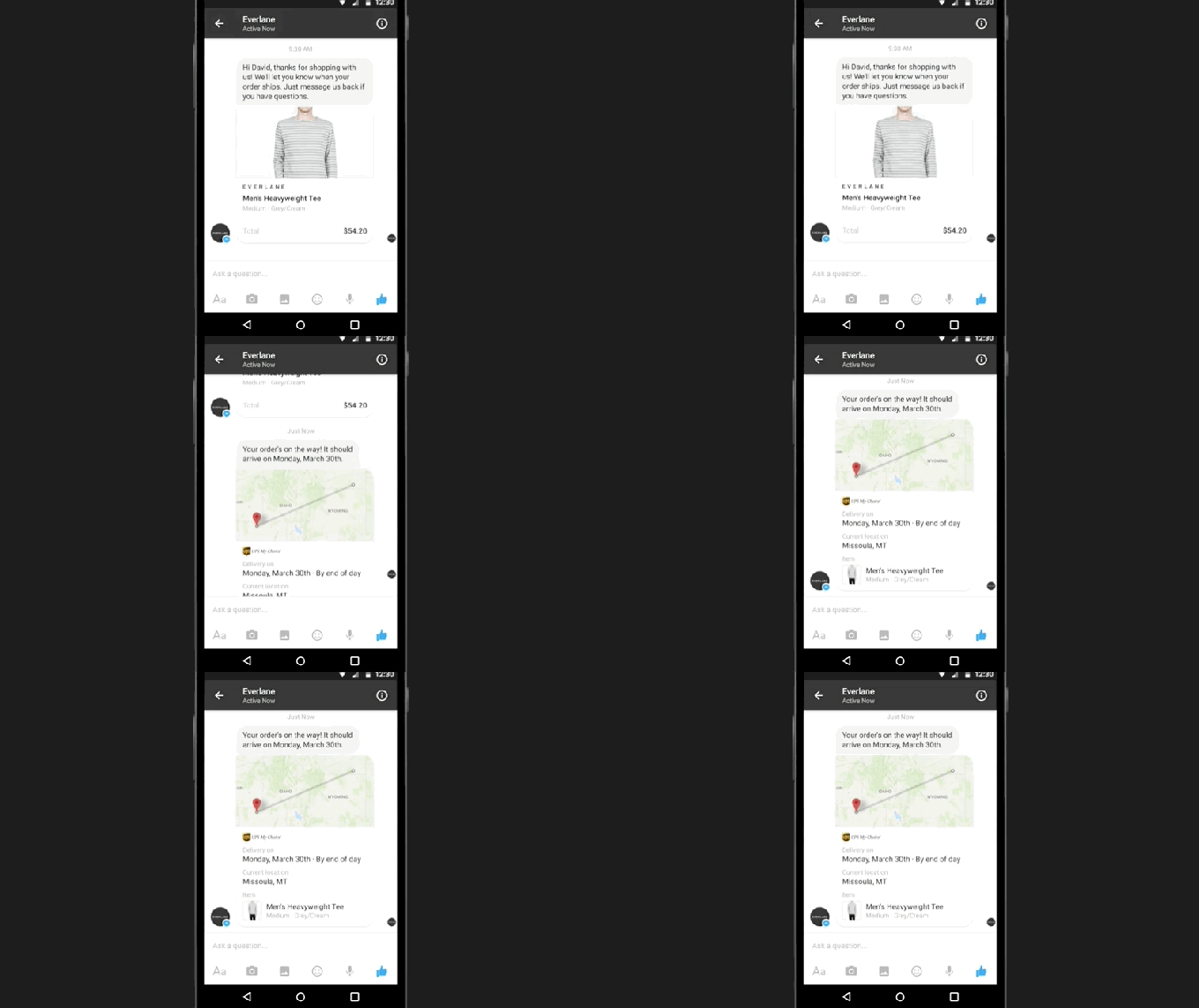
Facebook is also aiming to use Messenger to reinvent communication with businesses.
The idea is that people hate touch-tone phone tree customer service
calls. Endless email threads are annoying too. People would rather just
text asynchronously in a single chat thread.

To allow that Facebook is working with an initial set of
partners including Everlane and Zulily to change how people contact
them. For example, if you buy something through Everlane, but want to
modify, track, or return your order, you’ll be able to contact the
business through Messenger.

And rather than getting individual emails about order
confirmation and your order shipping, you’ll be able to opt to get those
messages in Messenger.

Customer support will be permitted over Messenger thanks
to an integration with ZenDesk. Businesses that already use live chat
systems for customer support will be able to run that communication over
Messenger.

Business will also be able to deliver push notifications
to customers through Messenger, even if the merchant doesn’t have its
own app. Businesses who want access to these features can apply here.

Not only could absorbing formerly clumsy
customer-to-business communication drive platform lock-in, it could give
Facebook valuable insight into commerce. The more Facebook knows about
what you buy and what businesses you interact with, the better it can
target its ads and tune its News Feed content.
As for what Facebook will do to monetize the business chat
side of the platform, Marcus tells me “Right now, nothing. But I think
that over time if we solve that problem for consumers, if we’re able to
allow merchants and businesses to reach their customers in a better way
and grow their businesses by doing that, we’ll figure out a good
business model. It will be legitimate because we solve problems for both
constituents.”
A New App Discovery Channel
While Messenger’s platform could increase engagement with
Facebook and help users express themselves and solve customer support
problems, it could also have a huge impact on app developers.

Messenger’s David Marcus
Right now, the app stores are overrun with crap and it’s
hard to find high-quality products. Messenger’s platform will create a
curated way to discover great apps, giving developers the exposure they
need to build their businesses.
Marcus explains that the two big problems the Messenger
content app platform solves are “1. It’s not easy to discover apps, and
2. It’s normally hard to share.” Even if you have an app already, you
have to go find and open it, create something, save it to your camera
roll, then find the right messaging thread, upload the piece of content,
and share it. Marcus insists “We’ve shortened the distance between
creating or finding great content, and sharing it with your friends.”
Facebook knew that to become the world’s top messaging
app, it couldn’t do all the work itself. By tapping third-party
developers and businesses to enhance it with content and business
correspondence, Messenger becomes more than just a chat app. It becomes a
communication layer between you and the whole world.